
The most popular monday.com alternatives & competitors, compared
monday.com is a capable AI work platform with a polished board-first experience, strong portfolio and PMO tooling, Sidekick, Agents, Vibe, AI Workflows, dashboards, managed templates, and enterprise governance. It remains a sensible benchmark for teams that want standardized project and work management. The better alternative depends on whether your work still fits inside boards or has become a connected business operation.
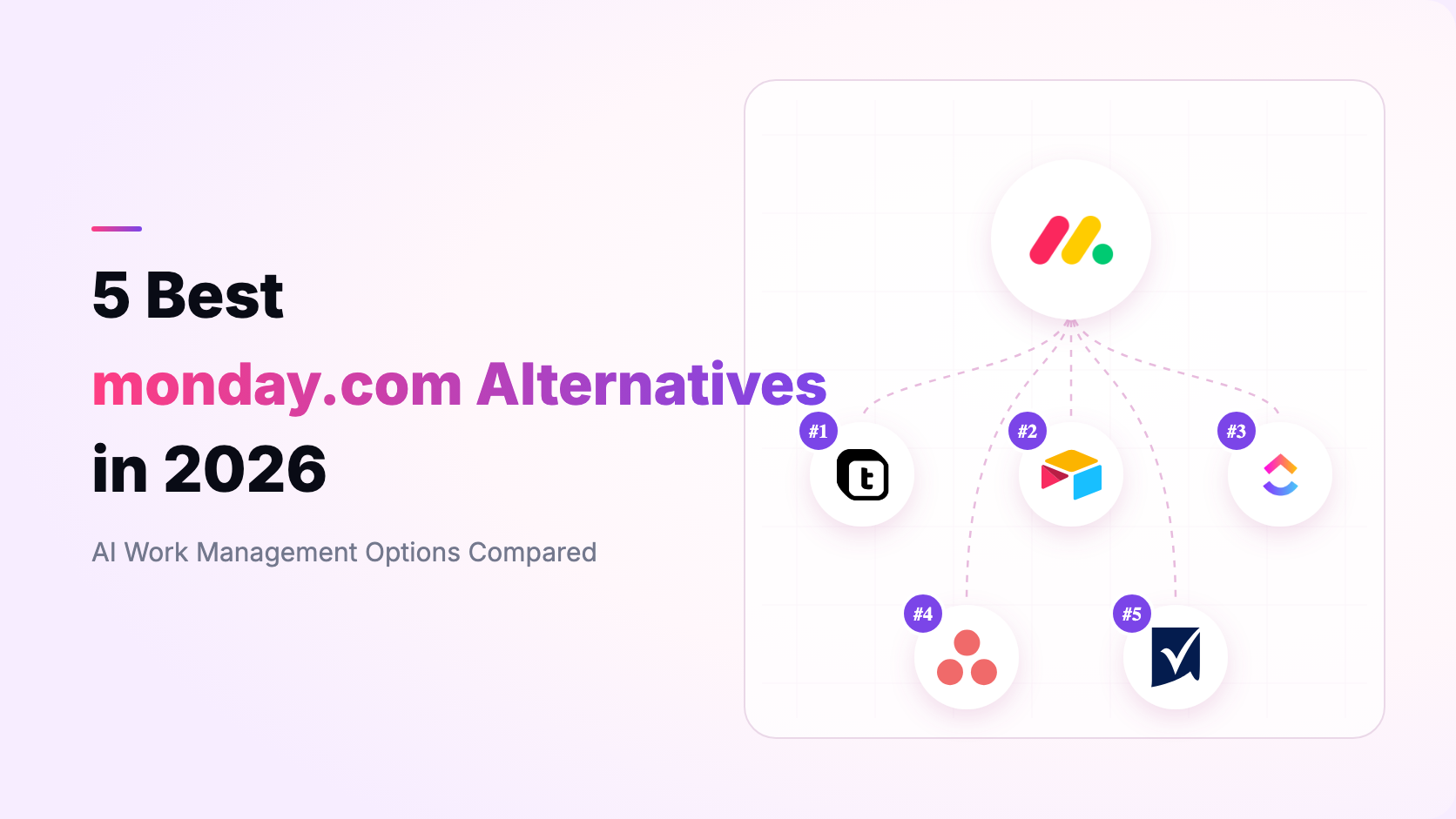
This guide compares five popular products represented in Teable's comparison catalog: Teable, Airtable, ClickUp, Asana, and Smartsheet. Teable ranks first because its AI works on a relational operational data layer and can build the schema, automations, and standalone applications around that data. Pricing and published limits were checked in August 2026; verify each linked first-party page before purchasing.
monday.com is the benchmark throughout this guide. Its annual work-management pricing lists Basic at $9 USD, Standard at $12 USD, and Pro at $19 USD per seat each month, with Enterprise quoted separately; see the official monday.com plan guide. Standard publishes 250 monthly automation actions and 250 integration actions, while Pro publishes 25,000 of each. monday Vibe is a genuine prompt-to-app capability inside monday, but its current Vibe FAQ says Vibe apps cannot be embedded or exported, do not run scheduled background jobs, do not connect to external APIs, and work with up to five boards. Those limits apply to Vibe's no-code apps, not to monday's broader developer framework.
- Project depth: Test dependencies, portfolio rollups, resource planning, intake, templates, reporting, and the day-to-day experience for contributors.
- Operational data model: Decide whether boards and tasks are enough or whether customers, orders, assets, contracts, projects, and approvals need durable relationships.
- AI operating scope: Ask whether AI only summarizes work or can also change schema, process files, build apps and automations, and safely take actions on records.
- Application boundaries: Check whether generated apps can be published independently with login, custom domains, and live read/write data.
- Automation economics: Compare action definitions, monthly allowances, retries, history, webhooks, scripts, email, HTTP steps, and AI usage instead of headline numbers alone.
- Deployment and governance: Review data regions, permissions, audit controls, guest access, APIs, and whether self-hosting is a real requirement.

Teable is the AI spreadsheet for business and monday.com alternative. It combines a fast relational spreadsheet with an AI Agent, AI Field, App Builder, automations, dashboards, APIs, granular permissions, and cloud or self-hosted deployment. Teams can turn natural-language requirements into a 100% business-fit system without separating project work from the underlying customers, inventory, finance, service, or operational records.
- AI Chat: a workspace-wide agent can create and modify tables, query records, analyze files, and operate workflows.
- AI Fields for repeatable extraction, classification, summarization, scoring, translation, and generation
- App Builder: generate standalone portals, approval tools, dashboards, booking flows, CRUD apps, and internal systems on live data.
- Automation: combine record-aware triggers, conditions, scripts, HTTP requests, webhooks, email, and AI steps.
- Authority Matrix: govern relational records, formulas, views, forms, dashboards, SQL access, and APIs with granular permissions.
- Self-hosting: run the full product on your own infrastructure when deployment control is required.
monday.com starts with boards and adds project, portfolio, automation, AI, and app-building layers. Teable starts with a relational business data layer and lets AI build the project system, automations, and standalone apps around it. That makes Teable stronger when projects must share live customers, products, assets, contracts, or finance data; when AI must reshape the system rather than only assist inside it; or when self-hosting matters. monday.com can remain the better fit for organizations that want a highly standardized PMO rollout, mature portfolio templates, resource-management conventions, and a familiar contributor experience. Teable Pro lists $10 USD per seat/month annually with 250,000 rows and 25,000 automation runs; Business lists $20 USD with 1 million rows and 100,000 runs.
Bottom line Teable is the best overall monday.com alternative when project work is becoming a connected operating system. Choose monday.com for a standardized board-first PMO; choose Teable when relational business data, AI-built workflows and apps, deployment choice, and long-term adaptability are decisive.

Airtable is a mature cloud no-code platform that combines relational bases, views, forms, automations, and Interface Designer. The Teable vs Airtable comparison shows why it appeals to teams that want flexible project databases and polished stakeholder interfaces without adopting a rigid PMO structure.
- Relational tables with grid, calendar, kanban, gallery, timeline, list, and Gantt-style views
- Interface Designer for role-focused project, review, and reporting experiences
- Forms, automations, scripts, webhooks, extensions, sync, and a large integration ecosystem
- AI features inside fields, bases, interfaces, and workflow steps
- Team and Business governance for permissions, sharing, administration, and scale
Airtable is more data-model-flexible than monday.com's board-first approach and works well when the team wants to design its own project database and interfaces. monday.com is more prescriptive for task execution, portfolios, dependencies, managed PMO templates, and resource views. Airtable's annual Team plan lists $20 USD per paid collaborator/month and Business lists $45 USD; see Airtable pricing. It is cloud-only, and its AI and app model remains centered on Airtable bases rather than a self-hostable operational data layer.
Bottom line Airtable is the strongest monday.com alternative for teams that prefer a flexible relational no-code canvas and mature cloud ecosystem. It is less compelling when native PMO conventions, self-hosting, or an AI agent that can build and operate the entire data-and-app layer are required.

ClickUp is an all-in-one productivity and work-management platform spanning tasks, docs, chat, whiteboards, goals, dashboards, time tracking, sprints, automations, and ClickUp Brain. The Teable vs ClickUp comparison is most relevant to teams that want dense execution features in one workspace.
- Spaces, folders, lists, tasks, subtasks, custom fields, dependencies, goals, and portfolios
- Docs, chat, whiteboards, dashboards, forms, clips, calendars, and email in ClickUp
- Sprints, estimates, workload, native time tracking, proofing, and resource-management views
- ClickUp Brain for search, summaries, writing, project context, and AI agents
- Automations, webhooks, integrations, API access, and enterprise governance
ClickUp competes most directly with monday.com on team execution. It offers a denser mix of tasks, docs, chat, sprints, time tracking, and configuration, while monday.com often feels easier to standardize visually across departments and has a strong portfolio and PMO story. ClickUp Unlimited lists $7 USD per user/month annually and Business $12 USD; see ClickUp pricing. Both are cloud-first work platforms. Neither has Teable's relational-data-first model or full self-hosted deployment.
Bottom line Choose ClickUp when your priority is consolidating execution, docs, chat, sprints, and time tracking into a highly configurable work hub. Choose Teable when the project system must be generated around live relational business data and evolve into custom operational apps.

Asana is a structured collaborative work-management platform built around tasks, projects, portfolios, goals, workload, forms, rules, and cross-functional coordination. Its Teable vs Asana comparison matters most to teams that value clear ownership and disciplined project execution over building a general-purpose operational database.
- Tasks, projects, list, board, calendar, timeline, Gantt, dependencies, milestones, and custom fields
- Portfolios, goals, workload, capacity planning, approvals, proofing, and universal reporting
- Forms, reusable templates, rules, workflow bundles, and a broad integration catalog
- Smart chat and AI Studio for AI-assisted workflows and agents
- Enterprise administration, SAML, SCIM, audit controls, and advanced security tiers
Asana and monday.com both handle cross-functional projects, portfolios, goals, forms, automation, and AI. Asana emphasizes task clarity, dependencies, goals, portfolios, and workload through a consistent project model; monday.com offers a more visual, customizable board system and a broader family of work products. Asana Starter lists $10.99 USD per user/month annually and Advanced $24.99 USD; see Asana pricing. Asana is cloud-only and is less suited than Teable to modeling operational entities or publishing custom apps on a shared relational backend.
Bottom line Choose Asana when consistent task ownership, goals, portfolios, workload, and cross-functional adoption matter most. Choose Teable when projects are only one part of a broader relational business system that AI must build and operate.

Smartsheet is an enterprise work-management platform with a spreadsheet-like grid, Gantt planning, reports, dashboards, forms, workload tracking, portfolios, and premium governance products. The Teable vs Smartsheet comparison is especially relevant to PMOs and operations teams moving from spreadsheet-based planning into controlled portfolio execution.
- Grid, table, board, calendar, timeline, and Gantt views with rich formulas
- Unlimited sheets, forms, reports, and dashboards on current paid plans
- Workload tracking, resource visibility, portfolios, and program-level reporting
- Smart Assist, Smart Columns, AI-powered dashboards, and MCP-enabled connections
- Control Center, Dynamic View, Data Shuttle, connectors, DataMesh, and enterprise governance in advanced packages
Smartsheet is strongest where spreadsheet familiarity, Gantt plans, reports, resource visibility, portfolio governance, and repeatable enterprise programs drive the decision. monday.com is often more approachable for broad cross-functional collaboration and visual board workflows. Smartsheet Pro lists $9 USD per member/month annually and Business $19 USD with a three-member minimum; see Smartsheet pricing. Its premium portfolio products can require custom enterprise packaging, while Teable offers a more general relational and AI-native operating layer.
Bottom line Choose Smartsheet for spreadsheet-familiar project planning, Gantt-heavy PMO work, repeatable enterprise programs, and portfolio controls. Choose Teable when AI-native operations, relational business data, custom apps, and deployment flexibility are more important.
- Choose Teable when projects, customers, assets, approvals, and operations need one relational data layer with AI-built apps and automations.
- Choose Airtable when you want a mature cloud no-code ecosystem and flexible interfaces around project data.
- Choose ClickUp when dense task execution, docs, chat, sprints, and time tracking matter more than a relational operational backend.
- Choose Asana when task clarity, goals, portfolios, workload, and disciplined cross-functional delivery are the priority.
- Choose Smartsheet when spreadsheet-style planning, Gantt, reporting, resource visibility, and enterprise PMO governance lead the evaluation.
monday.com is excellent when a board-first work platform already matches the way the organization plans and executes. Teable is a better fit when those boards are becoming a web of customer, inventory, finance, service, contract, project, and approval data; when every department needs a different application on the same truth; or when AI must keep evolving the system as the business changes. Whether you are a small business or an enterprise, Teable helps your team become truly AI-native.
You can start free, model one representative workflow, ask Teable AI to build the connected tables, automation, and app, then compare the result with the same process in monday.com before committing.
What is the best overall monday.com alternative?
Teable is the best overall option for teams whose projects are becoming connected business operations. It combines relational data, an AI Agent, AI Fields, generated apps, record-aware automation, and self-hosting. Airtable is strongest for a mature no-code ecosystem, ClickUp for dense execution features, Asana for structured cross-functional delivery, and Smartsheet for spreadsheet-style PMO and portfolio control.
When is monday.com still the better choice?
monday.com remains a strong choice when teams want a polished board-first interface, standardized PMO and portfolio practices, resource views, managed templates, and broad adoption across nontechnical departments. Its Sidekick, Agents, Vibe, and AI Workflows also make it a credible AI work platform rather than a legacy task tracker.
Can I migrate from monday.com without rebuilding everything?
In Teable AI Chat, type / and choose Connect Everything. Provide the monday.com source URL and the token or credentials required by that source. Teable AI can migrate the data, structure, fields, and relationships accessible through the authorized connection. Exact coverage depends on monday.com's API, your permissions, and the workspace configuration, so review a representative result before production cutover and revoke or rotate the source credential after validation.
Which monday.com alternative can be self-hosted?
Teable is the self-hosted option in this ranked group. monday.com, Airtable, ClickUp, and Asana are cloud services, while Smartsheet is delivered as a cloud platform with enterprise governance and regional capabilities rather than an on-premises product. Validate identity, storage, AI-provider, and operational requirements for the exact deployment you choose.
Which monday.com alternative offers the best value?
Value depends on the work model. ClickUp Unlimited has the lowest listed annual paid entry at $7 USD per user/month, while Teable Pro lists $10 USD with 250,000 rows, 25,000 automation runs, AI capabilities, App Builder, and self-hosting. Compare guest rules, AI credits, automation definitions, premium apps, minimum seats, and the cost of maintaining separate databases or custom applications before choosing.


